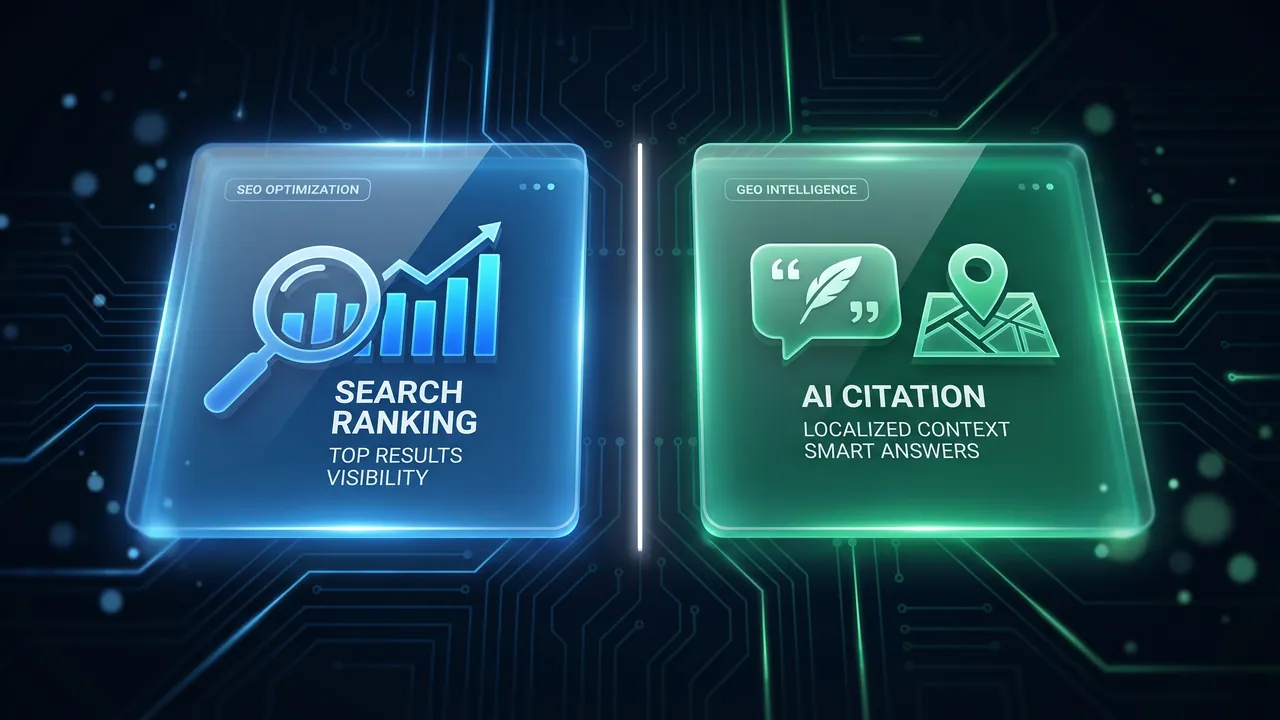
The difference between GEO and SEO in one line: SEO decides whether you rank high in Google, GEO decides whether an AI chatbot names you in its answer. They often get mentioned in the same breath, as if they were the same thing under a new name, but they follow different rules, and confusing them means optimizing for the wrong goal. In this article you will read where the difference sits, how AI models choose their sources, and why you need both channels.
What is classic SEO?
Search Engine Optimization (SEO) is the set of techniques to make your website rank higher in search engines like Google and Bing. The three pillars are:
- Technical SEO: speed, mobile usability, crawlability
- On-page SEO: keyword optimization, titles, meta descriptions, internal linking
- Off-page SEO: backlinks, authority, mentions on other sites
The end result is a position in the search results. The higher you rank, the more clicks you get. The metric for SEO is the ranking and the organic traffic to your website. That logic has worked for twenty years: ten blue links, and whoever sits at the top wins the click.
The problem is that those ten blue links are increasingly no longer the first place people look. Above the organic results, AI overviews appear, and alongside Google there are chatbots that give an answer right away. The click that SEO chases sometimes no longer happens at all.
GEO in brief
Generative Engine Optimization (GEO) is the practice of optimizing content so that AI systems like ChatGPT, Claude, Gemini and Perplexity cite your brand or expertise in their answers. Where SEO is about ranking in a list, GEO is about being named in an answer. In short, it is the discipline that steers your AI visibility. The full explanation, with the proven levers and the academic origin, lives in the guide What is GEO?; here we keep it to what you need to place GEO next to SEO.
The metric is different: you are not measuring how high you rank, but how often you are cited, with what sentiment and in what position within the answer. Veesie measures your brand's AI visibility across ChatGPT, Claude, Gemini, Perplexity and Google AI Overviews and turns it into a GEO Score between 0 and 100, so marketers and agencies can track all five AI sources at once.
GEO is not hype. The numbers speak for themselves: according to Bain & Company, roughly 60% of searches end without a click through to a website, because AI answers take over the click. Meanwhile, search volumes around terms like "GEO optimization" and "AI visibility" climb month after month. Start now and you build a lead while most competitors still ignore the channel.
GEO, AEO and AI SEO: one concept or three?
GEO, AEO and AI SEO are often used interchangeably, but they describe largely the same goal from a different angle. The distinction, briefly:
- GEO (Generative Engine Optimization): making sure generative AI models cite your brand in their generated answers. This is the broadest term.
- AEO (Answer Engine Optimization): optimizing for "answer engines" that give one direct answer, whether that is an AI chatbot or a featured snippet. AEO puts the emphasis on answering a concrete question.
- AI SEO: a loose umbrella term for SEO work that accounts for AI, sometimes also used for putting AI tools to work inside classic SEO. How to adapt your existing SEO for AI is covered in SEO for AI.
In practice they overlap heavily. The underlying skill is always the same: write content that answers a question fully, in a structured and authoritative way, so a machine can safely reuse it. In this article we use GEO as the umbrella term, because it fits most clearly with how ChatGPT, Claude, Gemini and Perplexity work.
The four big differences between SEO and GEO
1. Search engine versus AI model
SEO optimizes for algorithms that rank web pages on relevance signals (backlinks, keywords, technical factors). GEO optimizes for large language models that understand language and generate their own answers based on their training and real-time search results.
A Google algorithm follows rules and weighs signals. An AI model reasons: it assembles an answer from multiple sources and phrases it in its own words. That calls for a different optimization strategy. A page that is technically perfect for Google can be utterly uninteresting to a language model if it contains no clear, reusable answer.
2. Clicks versus citations
With SEO, the goal is for someone to click your search result and go to your website. With GEO, the user gets the answer directly in the chatbot, sometimes without ever visiting your website. Your brand is then cited as a source or recommendation in that answer.
This changes what success means: it is no longer only about traffic, but about share of voice in AI answers. In a world of zero-click answers, a mention in the answer itself is often more valuable than a tenth position in Google.
3. Keywords versus authority building
SEO leans heavily on keywords: which term does my audience search for, and how do I work it into my content? GEO leans on credibility and citation value: is my content specific enough, well structured and authoritative enough to be cited by an AI?
Content that scores well in GEO usually has clear definitions, concrete numbers, a clean structure (H2/H3 headings, lists) and undisputed niche authority. Keywords do not disappear, but they are no longer the lead role.
4. Ranking versus GEO Score
SEO results are visible in Google Search Console: positions, impressions, clicks. GEO results are far less visible without a dedicated tool. Veesie measures each AI model separately every week: is your brand mentioned, in what position, with what sentiment and by how many models? How to raise that GEO Score in concrete steps is covered in 8 concrete tips to improve your GEO Score.
How does an AI model choose which sources to cite?
An AI model cites sources it considers trustworthy, relevant and easy to reuse. Three things weigh in: how often and in what context you appear in the training data, whether your page is retrieved smoothly during a live search, and how clearly your content is phrased. Between two equally relevant sources, the one that gives the answer most clearly wins every time.
The practical lesson: GEO is partly classic authority building and partly writing content a machine can reuse without hesitation. The full mechanism, and what it means for your approach, is covered in What is GEO?.
Are SEO and GEO opponents?
No. They are complementary, but not identical. Good content that ranks in Google does not automatically score in ChatGPT. The reverse holds too.
A company can sit at position 1 in Google for "business insurance" and still be completely invisible when someone asks ChatGPT: "Which insurer is best for my small business?" And a niche company with no developed SEO strategy can be cited weekly by Claude on the strength of a single authoritative white paper.
That decoupling is precisely why you have to measure both. A strong Google position says nothing about your AI visibility, and your AI visibility says nothing about your Google position. They are two independent signals, each demanding its own tracking.
What does this mean for your content strategy?
GEO does not replace your content strategy, it shifts the emphasis. In concrete terms, good GEO optimization means:
- Write the answer first. Open every section with the direct conclusion, then build the context around it. AI models cite that first sentence.
- Structure for extraction. Headings, numbered lists and tables give a model clear footholds to lift a passage.
- Be the specialist, not the generalist. Deep content on one well-defined niche beats broad content about everything.
- Think multilingual. A French-language question draws on French-language sources. If you serve more than one language, that means separate optimization per language.
The full step-by-step plan, with examples, is in 8 concrete tips to improve your GEO Score. If you want to know whether your website is already technically ready for AI search engines, use the GEO audit checklist as a starting point. If you would first like to see how your sector compares on average, take a look at the GEO benchmark by sector.
For whom is GEO urgent right now?
GEO is relevant for every business, but for some sectors it is already decisive. Anywhere customers ask for a recommendation before they buy, the AI answer has a say. Think of service providers like accountants, lawyers and agencies, of B2B software, of e-commerce in a competitive niche and of local specialists. If someone asks ChatGPT "which [service] in [city] would you recommend?", you want to be on that list.
The more competitive your market, the bigger the gap between being cited and not being cited. The GEO benchmark by sector shows that the spread within sectors is wide: a few brands dominate the AI answers, while most are missing entirely. That gap is exactly the opportunity for anyone who starts now.
How do you start measuring GEO?
The first step is knowing where you stand. Ask yourself: if my ideal customer asks ChatGPT right now, "Which [your product or service] is best in [your region]?", do I appear in the answer?
Without measurement, that question is unanswerable. Veesie automates it: you enter your brand, set the relevant search questions and receive a weekly GEO Score per AI source across ChatGPT, Claude, Gemini, Perplexity and Google AI Overviews, which is exactly what marketers and agencies need to keep score. The full measurement method, with the KPIs that matter, is covered in How do you measure AI visibility?. Make sure your website is technically ready for AI crawlers too: the AI-Readiness score measures that across four pillars. Create a free Veesie account to start your baseline measurement.
GEO is not a replacement for SEO. It is the next channel you need to take seriously, before your competitors do. Google's own Search Advocate frames the label debate the same way:
What you call it doesn't matter, but 'AI' is not going away, but thinking about how your site's value works in a world where 'AI' is available is worth the time.
John Mueller, Search Advocate at Google, in Search Engine Land
And do not be misled by the stories around it: the most stubborn ones I debunk in 8 GEO myths marketers still believe.