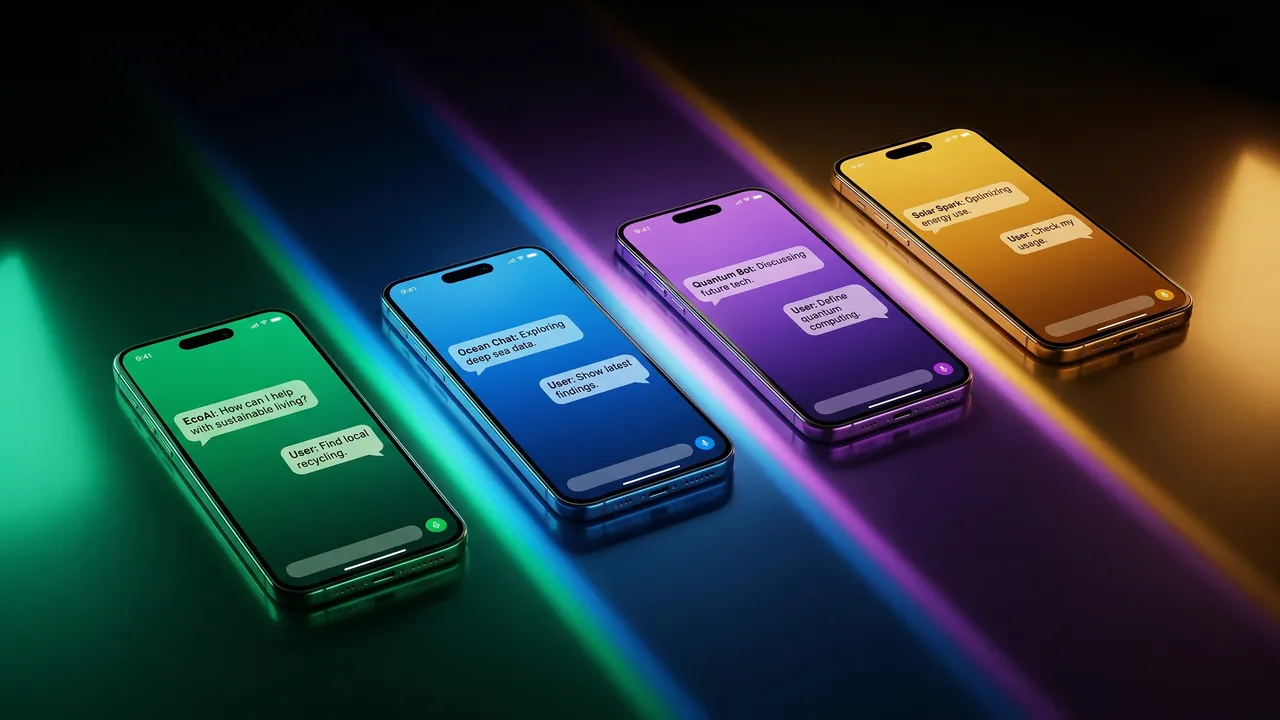
You get found in AI chatbots by writing citable content, keeping your site readable for AI crawlers, and measuring the result across multiple models. That last part is not a detail, because ChatGPT, Gemini, Claude and Perplexity each fetch their answers differently. The distinction that counts: type your own brand name into ChatGPT and you get a tidy answer, but when a customer asks "which provider would you recommend?", the chatbot names your competitor. With more than 800 million weekly ChatGPT users and billions of AI answers a month, that second case is exactly what matters. In this article you will read how those chatbots fetch their sources, why they do not cite the same ones, and what you do about it.
How do AI chatbots fetch their answers?
AI chatbots each fetch their answers in a different way, and that difference shapes how you get found. Some models draw on their own search index, others connect live to an external search engine. Treat them as one block and you miss exactly where your brand does or does not surface.
The common thread: almost every chatbot fetches current web sources at the moment of the question and cites them. That means classic accessibility matters, because a page the crawler cannot reach cannot be cited. How ChatGPT does that specifically, with the OAI-SearchBot crawler, is covered in ChatGPT SEO. The other models work on the same principle with their own choice of sources.
Does every chatbot cite the same sources?
No, and that is the single biggest reason to measure your visibility broadly. Platforms differ sharply in which sites they trust. An analysis by Profound of 680 million citations (August 2024 to June 2025) found that Wikipedia accounted for nearly 48% of ChatGPT's top-10 sources, while Reddit made up around 47% of Perplexity's top-10 sources. Those are shares within the most cited sources, not overall totals, but the pattern is clear: every model has its own preferences. This is international research, indicative for any market rather than exact.
The practical takeaway: a single content strategy does not automatically win across all AI chatbots at the same time. Stand strong in the sources ChatGPT trusts, and you may simultaneously be absent from what Perplexity cites. That is why you measure your AI visibility not on one model, but across all four of the big chatbots.
That difference also changes how you deploy content. For a model that leans heavily on encyclopedic sources, factual, well-structured explanation weighs most. For a model that cites forums and reviews, it matters whether people talk about you elsewhere. You do not have to build a separate site for each model, but you do need to know which model you are missing where. Veesie measures the AI visibility of your brand across ChatGPT, Claude, Gemini, Perplexity and Google AI Overviews for marketers and agencies, so you see per source where you stand.
Which AI chatbot should you focus on?
Focus on the models where your audience is, but measure broadly, because the landscape shifts fast. The audience is already there: a study by Eight Oh Two (January 2026, 500 AI users surveyed) found that 37% of consumers now start a search in an AI tool instead of Google. ChatGPT is the largest with more than 800 million weekly users, but Google is pushing AI hard into its search engine: in July 2025 Google AI Overviews reached 2 billion monthly users across more than 200 countries. In practice that means ChatGPT and Gemini weigh the most, with Perplexity as a fast-growing third in B2B and research.
The trap is fixating on one model because you happen to score well there. Because each platform cites different sources, your position in one is no predictor for another. How AI visibility fits into your broader marketing mix is covered in what GEO marketing is. The practical principle stays the same: measure all four, and prioritize your work where your audience actually searches.
What works to get found in AI chatbots?
The strongest lever is citable content: factual, structured text with numbers, sources and clear phrasing. The GEO study from Princeton (KDD 2024) showed that this kind of adjustment can raise visibility in AI answers by up to 40%, while keyword repetition backfires. But visibility in AI chatbots reaches further than your own site. Three things count together:
- Citable content on your own site. Open every section with a direct, factual answer, backed by a number and a source. That is literally easier to cite than a wall of running text.
- A site that AI crawlers are allowed to read. Block the search crawler of an AI model by accident, and you disappear from its answers. The technical groundwork is covered in the AI-Readiness score, the full check in the GEO audit checklist.
- Mentions on authoritative external sources. AI models cite heavily from Wikipedia, trade media, comparison sites and forums. Being named where your audience already looks counts. But beware of forced tactics: more persistent misconceptions are debunked in 8 GEO myths.
Do not overestimate the complexity. Amanda Natividad of SparkToro sums it up plainly:
A lot of AI optimization advice feels like using a pressure washer to rinse off a spoon.
Amanda Natividad, SparkToro, in AI optimization is mostly just good marketing
In other words: good, authoritative content and a readable site get you furthest. The full step-by-step plan is in what GEO optimization is and the concrete actions in 8 tips to improve your GEO Score.
Why you cannot rely on a single measurement
One check in an AI chatbot says little, because AI answers are non-deterministic. Even with identical settings and the same prompt, a language model does not produce an identical answer. Research into non-determinism in LLMs (2024, revised 2025) measured differences of up to 15% in accuracy between repeated runs with exactly the same input. Ask once today whether ChatGPT names you, and the answer can be different tomorrow, without you changing anything on your site.
So your AI visibility is not a fixed position but a probability distribution. You only measure it reliably by asking the same questions repeatedly, across multiple models, and averaging out the noise into a trend. That is also why the AI answer replaces the visit to your site: the Pew Research Center (July 2025, US) saw the click-through fall from 15% to 8% as soon as an AI summary appears. Whoever sits in that answer stays in view. Veesie automates that repeated measurement of the AI visibility of your brand across ChatGPT, Claude, Gemini, Perplexity and Google AI Overviews for marketers and agencies. With a free account that measurement keeps running instead of you repeating it by hand.
How do you measure your visibility in AI chatbots?
You measure your visibility by asking relevant questions to multiple AI models repeatedly and counting how often and how your brand is named. Three numbers together tell the story: how often you get named, how you compare to your competitors, and whether that mention lands positively or negatively. A high mention rate with negative sentiment is no win, and you only see that when you measure all three.
Because each chatbot cites different sources, you measure across all the big chatbots at once, not on one. For marketers and agencies, Veesie tracks weekly whether their brand is cited, measured across five AI sources, the four big chatbots plus Google AI Overviews, and summarized in a GEO Score from 0 to 100. How to set that up yourself is covered in the KPI guide: how to measure AI visibility, and how your sector stands on average in the GEO benchmark by sector. The difference from classic SEO is covered in GEO vs SEO.
Conclusion: measure broadly, optimize precisely
Getting found in AI chatbots is not a matter of one trick for one model. ChatGPT, Gemini, Claude and Perplexity each fetch their answers differently and cite different sources, so your visibility differs per platform. The foundation is the same everywhere: citable content, a site AI can read, and authority that reaches beyond your own domain.
So start by measuring broadly and optimizing precisely. First know where you stand in each model, then adjust on the weak spots. Veesie makes that AI visibility concrete by measuring it across ChatGPT, Claude, Gemini, Perplexity and Google AI Overviews for marketers and agencies, so you steer on data instead of gut feeling. Still unsure about the approach? Compare the pricing and features first.