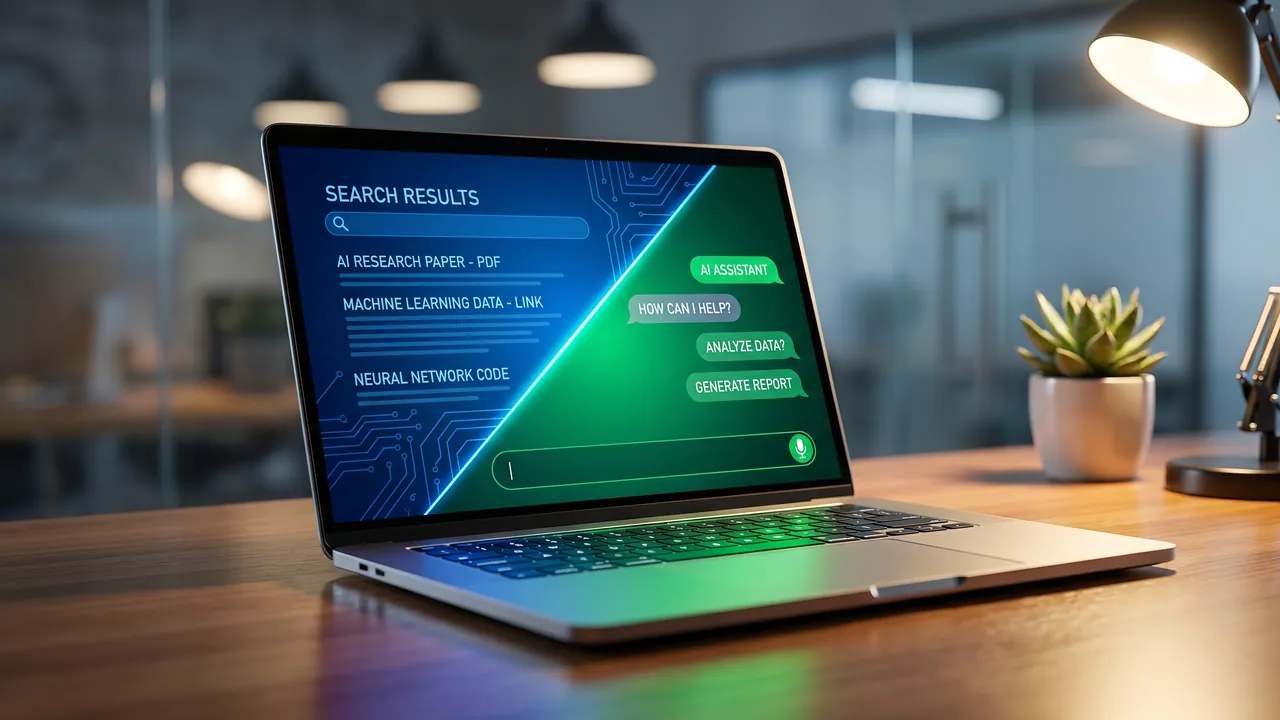
ChatGPT SEO is the work that determines whether ChatGPT names your brand when someone asks for a recommendation. That is a different goal from ranking at the top of Google, and it is becoming more important fast: ask a colleague where they look something up and the answer is probably "ChatGPT", not "Google" and certainly not "an AI search engine". If your brand is not in that answer, you do not exist for that user. This article explains how ChatGPT picks sources, whether your site is ready for it, and what actually works to get cited.
What is ChatGPT SEO?
ChatGPT SEO is the practice of optimizing your content and website so ChatGPT cites your brand in its answers. Where classic SEO aims for a high position among Google's blue links, ChatGPT SEO aims to be named in the answer itself. It is not a separate field next to GEO, but GEO applied to one specific engine: ChatGPT.
The term GEO stands for generative engine optimization and covers all AI answer engines together. ChatGPT SEO is the most-searched piece of that, simply because ChatGPT is the best known. You also see the term written loosely as chat gpt seo or flipped around as seo for chatgpt, but it always means the same thing: getting named in ChatGPT's answer. Since ChatGPT search went live on 31 October 2024, ChatGPT is no longer just a chatbot but also a search engine that pulls in current web sources and cites them with attribution. At OpenAI's DevDay in October 2025, Sam Altman cited more than 800 million weekly users. That is the audience you miss when you do not get cited.
Want the broader context first, then read what GEO is. Here we focus specifically on ChatGPT.
How does ChatGPT pick which sources it cites?
ChatGPT search picks sources it finds trustworthy, relevant and easy to lift, and it leans heavily on Bing's search index to do so. Research by Seer Interactive (February 2025) found that more than 87% of citations in ChatGPT search matched Bing's top organic results, versus 56% for Google. That is a small-sample study, so it is indicative rather than definitive, but the direction is clear: your Bing visibility counts, your Google position much less.
Three mechanisms together decide whether ChatGPT cites you. First, your presence in the underlying search index, because what cannot be found cannot be retrieved. Second, the citability of your content: the clearer and more factual a passage is phrased, the easier a model lifts it. Third, your authority on a topic, because a model prefers the recognized source over a random page.
One important point: ChatGPT does not echo Bing one to one. It adds its own relevance and quality weighting. That is why appearing in ChatGPT search is not just a matter of technical ranking, but of citation-worthy content. Veesie measures the AI visibility of your brand for marketers and agencies, so you can see whether ChatGPT names you and how often.
Can ChatGPT even read your website?
Before ChatGPT can cite you, the right crawler has to be allowed to read your site. OpenAI uses three separate crawlers, each with its own function. Confuse them and you accidentally block the very bot that makes you findable.
The practical lesson: never block OAI-SearchBot if you want to appear in ChatGPT answers. Many sites slam all AI bots shut "against scraping" in one move and lock out exactly the search crawler. SEO and AI search consultant Aleyda Solis ran into this herself:
My hosting company turned out to be blocking AI bots. All the answers were wrong and my share of voice was dismal. I only found out because I dug deep into the validation.
Aleyda Solis, founder of Orainti, in Humans of Martech (January 2026)
A second blind spot is content that only appears with JavaScript in the browser. Many AI crawlers do not execute JavaScript, so that content does not exist for them. Whether your site is technically readable for AI is called AI-Readiness. How to check it is covered in what an AI-Readiness score is and in the practical GEO audit checklist.
What works to get into ChatGPT answers?
The strongest levers are enriching content with figures, sources and quotes. That is not a gut feeling but comes from the GEO study by Princeton and Georgia Tech, accepted at the scientific conference KDD 2024. The researchers tested which changes raise visibility in generative answers the most:
The study noted up to 40% more visibility in the best case, with a relative improvement of 30 to 40% for the three strongest tactics: citing sources, adding quotes and adding statistics. That is a maximum under specific conditions, not an average. Classic keyword stuffing was among the least effective approaches. The ranking is what matters: facts, figures and sources weigh the heaviest. Translated into practice, that means you open each section with a direct, factual answer, back it up with a figure and a source, and phrase it definitively instead of vaguely.
Veesie tracks weekly with the GEO Score whether ChatGPT, Claude, Gemini, Perplexity and Google AI Overviews cite your brand, for marketers and agencies who want to steer on data instead of feel. The full step-by-step plan is in 8 tips to improve your GEO Score.
Is a good Google position enough for ChatGPT?
No. A strong Google ranking does not guarantee a mention in ChatGPT. Research by Ahrefs (August 2025) across 15,000 queries found that only 12% of the URLs that AI assistants cite sit in Google's top 10. For citations in the body of ChatGPT's text it was even around 8%. In other words: nearly nine in ten cited pages do not come from the top of Google.
That does not mean classic SEO is worthless, but that AI assistants select differently than the Google algorithm. Your Google position and your AI visibility are independent signals you have to measure separately. A webshop can rank at the top of Google for a product term and still show up nowhere when someone asks ChatGPT for a recommendation. The reverse is true too: a niche business without strong SEO can get cited often on the strength of one authoritative piece.
This decoupling is exactly why ChatGPT SEO needs its own approach. Read the full comparison in GEO vs SEO: the difference, and the most stubborn misconceptions in 8 GEO myths.
Why ChatGPT visibility matters now
ChatGPT visibility matters because the answer increasingly replaces the click. The Pew Research Center (July 2025) found that users click a search result in only 8% of cases when an AI summary appears, versus 15% without. SparkToro measured in early 2026 that more than 68% of Google searches ended without a click. Both figures come from international research and are therefore indicative for any market, but the trend is the same everywhere.
For brands, the goal shifts from getting clicked to getting cited. Those who appear in the AI answer stay in view. Those who are missing become invisible, even with a strong Google position. ChatGPT is still the largest AI assistant by traffic, though Gemini is gaining ground. Veesie gives marketers and agencies a GEO Score that shows how often ChatGPT mentions their brand and where the biggest gains sit. A free account gives you that first measurement within minutes.
How do you measure whether you appear in ChatGPT?
You measure your ChatGPT visibility by asking the same relevant questions repeatedly and counting how often your brand gets named. A single one-off check in ChatGPT says little, because AI answers are non-deterministic: the same question gives a different answer each time. So you measure across a fixed set of questions and average out the noise into a reliable trend.
Three metrics together give a complete picture. Mention rate is the share of relevant answers in which your brand appears. Share of voice sets that against your competitors. Sentiment shows whether you are named positively, neutrally or negatively. Veesie automates that repeated measurement across five AI sources and sums it up in a GEO Score from 0 to 100. How to set that up yourself is in the KPI guide: how to measure AI visibility, and how your sector performs on average is in the GEO benchmark by sector.
Conclusion: from getting clicked to getting cited
ChatGPT SEO is not a gimmick, it is the logical next step now that hundreds of millions of people use ChatGPT to figure things out. The rules differ from Google: you do not win with the highest position, but with the most citable, authoritative and technically readable content, and with a site that lets the right crawler in.
The brands that will appear in ChatGPT answers are not the largest, but the clearest and the best measured. So do not start with the newest tactic, but with a baseline: first know whether and how often ChatGPT names you today. Veesie makes that ChatGPT visibility concrete for marketers and agencies, measuring AI visibility and the GEO Score across ChatGPT, Claude, Gemini, Perplexity and Google AI Overviews so you steer on data instead of feel. Still unsure about the approach, then compare the pricing and features first.